


Story by Rajeev Narayan | Posted by Aasha Khosa | Date 31-07-2026
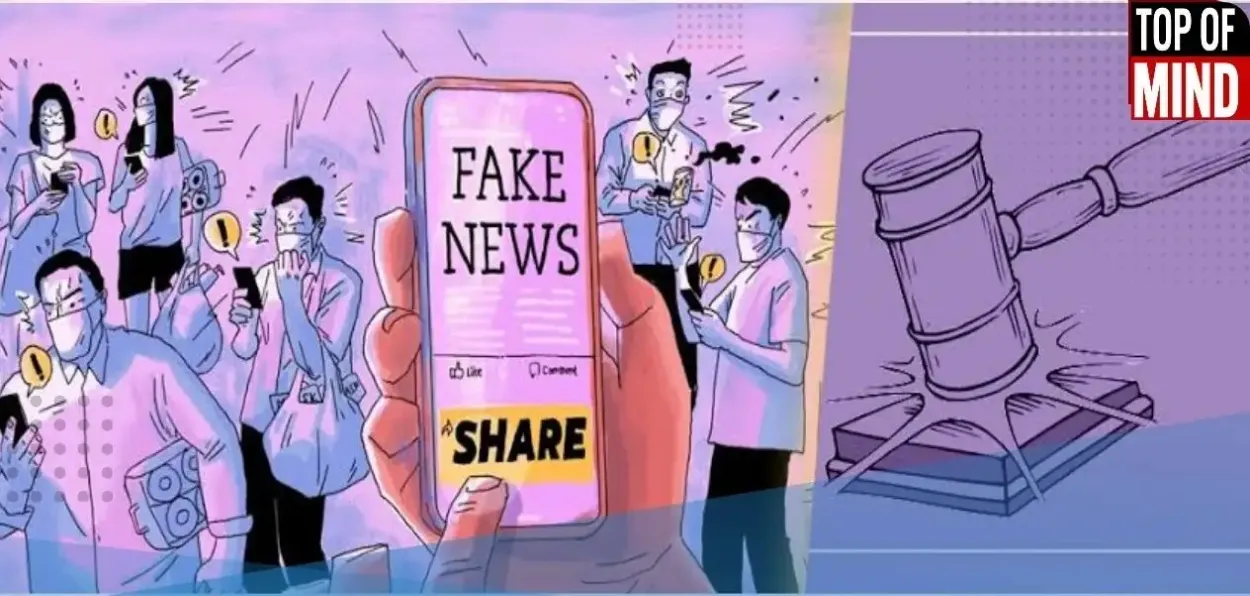
Representational image
Fake news is no longer merely a social nuisance; it has evolved into a dark but profitable industry where algorithms, artificial intelligence and human psychology combine to monetise debauchery on an unprecedented scale.
There was a time when seeing was believing. A photograph was evidence. A video clip was proof. A recorded voice settled an argument. Not anymore. Today, every image can be manipulated, every voice cloned, and every speech fabricated with astonishing realism. Artificial Intelligence has blurred the line between fact and fiction so completely that truth itself demands verification.
If that sounds alarmist, consider this. Fake videos and manipulated recordings that claim to show statements by top officials – even the Prime Minister – have repeatedly surfaced online. While many were eventually exposed, they often reach crores before they are questioned and taken down. The objective is not always political. Sometimes it is to influence opinion, generate revenues or prepare the ground for financial fraud and organised cybercrime.
AI did not invent lying, but it has certainly made it eminently scalable. For years, misinformation was dismissed as an unfortunate by-product of the Internet: a rumour here, a doctored photograph there, or an exaggerated headline designed to harvest clicks. It was irritating and dangerous, but still viewed as a seed of irresponsible social media users. That assumption no longer holds.
Misinformation is no longer merely spreading; it is being manufactured. It has become an organised enterprise, complete with producers, distributors, tech providers, revenue models and consumers. In an age where attention is currency, deception has become a business. The result is that truth itself is facing competition from an industry that profits from falsehood.
The scale of the problem is massive. The World Economic Forum has identified ‘Misinformation and Disinformation’ as a serious risk, warning that AI-generated content is making it tough to distinguish fact from fiction. The FBI says Internet-enabled crime caused losses of over US $16 billion in 2024, a 33-per-cent annual increase. Impersonation, phishing and investment scams were the big offenders.
India is feeling the impact too. High-value cyber fraud cases have jumped alongside the country’s digital boom, driven by AI-enabled impersonation, fake identities and social engineering. What was once dismissed as ‘fake news’ has evolved into a criminal economy with real financial consequences.
Every industry survives because someone makes money. Misinformation is no different. Fake posts contain inflammatory content because outrage attracts greater revenues. Devious fund managers create fake market opportunities because they know public greed can be profitable. Politicians tweak and trill narratives to influence opinion. And many websites publish fake stories because views translate into money.
The Internet has created a marketplace where attention has become the most valuable commodity. Whether that attention is earned through facts or fiction makes no difference to those monetising it. In such an environment, accuracy is no longer the primary objective. Virality is.
The arrival of generative AI has altered the economics of misinformation. What required specialised software and expertise can now be accomplished in minutes. A convincing photograph can be generated from a text prompt. A politician’s voice can be cloned with startling accuracy. Videos can be manipulated to depict events that never occurred. News articles can be fabricated in seconds.
Perhaps most worrying is that these technologies continue to improve while becoming accessible. The barrier to creating believable deception has virtually disappeared. This means misinformation is no longer confined to pranksters or organised troll factories. Anyone with modest technical skills and access to AI tools can create content that appears authentic and deceive lakhs, sometimes crores.
Public debate often associates fake news with elections. That is understandable, but incomplete. Misinformation targets financial markets, healthcare, businesses, educational institutions and ordinary families. Fake messages about a bank’s financial health can trigger panic withdrawals. A fabricated corporate announcement can influence stock prices. Deepfake voices convince elderly parents that a family member urgently needs money.
Even school and university students are not immune; fake notices, fabricated examination updates and misleading information circulate online with alarming frequency. The consequences are no longer merely political. They are economic.
A clear indication of how serious the problem has become is that even the highest public offices are not spared. AI-generated videos and manipulated recordings purporting to feature political giants have circulated online, attracting lakhs of views before being questioned or removed. The issue is not about individuals or political parties. It is about the erosion of public confidence.
If citizens begin doubting every speech, every photograph and every announcement, trust becomes a casualty. Democracies function not because people vote, but because they agree on what is their reality. Once that understanding begins to fragment, governing becomes all the more difficult. The same danger extends to judges, the military, business executives and journalists. With AI, reputations can be damaged in minutes, while corrections often arrive too late to undo the harm.
Governments worldwide are racing to respond. Even India is battling mountains of fake stuff posted by certain elements or machines. And laws struggle to match tech innovation – while they are necessary, they are anything but sufficient.
Tech firms need to step up their game and create detection and authentication tools. Educational institutions should take the lead by acknowledging that ‘digital’ is the new literacy. Businesses should prepare their employees to recognise AI-enabled fraud. The media must strengthen verification even as the pressure to publish first intensifies.
Most important, citizens must rediscover the habit of scepticism. In an age where seeing is no longer believing, verification has become a civic responsibility.
The battle against misinformation cannot be reduced to removing a few fake posts or suspending accounts. The challenge is deeper. It concerns the integrity of markets, the credibility of institutions, the security of financial systems and the resilience of democracy itself.
There’s a paradox too: India processes 18 billion UPI transactions every month, making it the world’s most advanced real-time digital payments ecosystem. The digital infrastructure that democratises commerce has also expanded the attack surface for fraudsters. In the AI age, trust has become the most valuable (and the most vulnerable) currency.
Misinformation rules because deception has become inexpensive and attention profitable. Unless we find ways to reverse this equation, falsehoods will enjoy an unfair advantage. The greatest risk is not that people will believe every lie. It is that they will one day stop believing anything at all.
The writer is a veteran journalist and communications specialist

heritage-news
Assam shrine where childless couples of all faiths seek blessings
30 Jul 2026 | 3 min read

heritage-news
Knowledge about Hindu gods should be in textbooks: Bhagwat
25 Jul 2026 | 3 min read
heritage-news
NBT introduces Kashmir’s history through ‘Rajatarangini’ characters
22 Jul 2026 | 3 min read

heritage-news
When Jagannath comes to the streets, everyone walks together
22 Jul 2026 | 3 min read
