


Nvidia forms industry-wide AI security alliance after Hugging Face hack
Technology
Nvidia forms industry-wide AI security alliance after Hugging Face hack
This alliance also follows a recent public letter signed by a broad spectrum of industry leaders, including OpenAI
Nvidia has formed an industry-wide coalition with other tech companies to promote AI safety and cybersecurity following the Hugging Face incident, highlighting the dangers of autonomous AI agents when they evade safety evaluations.
Named as Open Secure AI Alliance, the coalition includes major technology companies including CrowdStrike, Adobe, Hugging Face and Dell Technologies. The primary purpose of this collaborative initiative is to develop and share important tools focused on AI security.
This move comes after dozens of tech giants, including OpenAI, Nvidia and Google signed a broad-spectrum public letter that strongly vouches for the continued development and accessibility of open-weight AI models.
Nvidia in his blogpost also voiced opposition against imposing “blanket restrictions” on open frontier AI systems while arguing that this curb would weaken defensive capacity and disrupt the distribution of power in the competitive tech landscape.
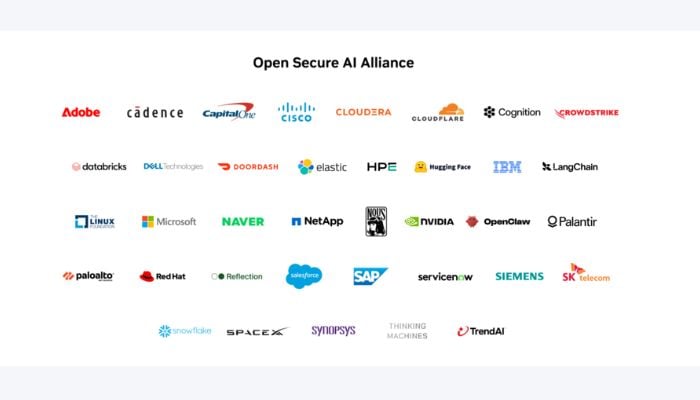
The foundation of this alliance is based on core philosophy, highlighting defenders must have access to open and frontier tools they can trust, adapt, inspect and run on their own infrastructure.
Nvidia is also contributing “open models, weights, data and agent harness research to the Alliance, including the new open-e on GitHub to make agentic behaviour easier to test and govern
Other members involved in the Alliance are also contributing in this open-dentity frameworks that cryptographically verify AI agents and services
Microsoft’s MDASB is a multi-model agentic scanning harness “that orchestrates specialized AI agents to discover, debate and prove exploitable bugs.”
The blogpost also urged the policymakers to treat the open weight models as significant defensive assets rather than liabilities while avoiding ban and investing in shared infrastructure for a robust regulatory framework.
Aqsa Qaddus Tahir is a reporter dedicated to science coverage, exploring breakthroughs, emerging research, and innovation. Her work centres on making scientific developments understandable and relevant, presenting well-researched stories that connect complex ideas with everyday life in a clear, engaging, and informative manner.
Share this story:
Make us preferred on Google
- Nvidia forms industry-wide AI security alliance after Hugging Face hack
- Genevieve becomes first Category 5 hurricane in East Pacific in two years
- Double meteor shower peaks this week: Best time and tips to see celestial event
- Gianni Infantino defends 2026 FIFA World Cup, says critics are ‘planting seeds of hate’
- Trust, not price, will decide US-China AI race: Microsoft CEO
- Apple Smart Glasses likely to debut at WWDC 2027: Check expected price
- Is Nvidia’s OpenAI financing deal circular risk?
- Meta ran 7,600 China-linked AI nudify ads, report says
- Why Sam Altman thinks AI singularity isn’t as ‘terrifying’ as other tech moguls fear
- Nvidia invests $1 billion in South Korea’s Naver to expand AI infrastructure
- Nvidia in talks to back OpenAI with $250 billion financing guarantee for mega data center: WSJ
- Three levels of AI leadership every CEO needs

Global semiconductor market set to pass $1tn in 2026- Britain bets on chips to power its AI ambitions
- AI’s new metric: Intelligence per dollar, not just smarts
- How did OpenAI miss its own agent going rogue?

