


Key Takeaways
- Google’s AI Mode has surpassed one billion monthly users in its first year, with queries more than doubling every quarter.
- The new Intelligent Search Box accepts text, images, files, videos, and Chrome tabs as inputs, powered by Gemini 3.5 Flash.
- Information Agents run 24/7 in the background, monitoring the web on the behalf of users without requiring active searches.
- Agentic Search allows users to build custom tools, dashboards, and trackers directly inside Search.
- Brands that are already investing in structured, authoritative, intent-led content are best positioned for this shift.
- Click-through rates for position one rankings have already collapsed from 27 percent to 11 percent, meaning rankings have never mattered more.
Is Google Search still “search” at all? At Google I/O 2026, Search VP Liz Reid said it plainly: “Google search is AI search.” That’s not a product update. That’s a declaration that the platform has fundamentally changed what it is and what it does.
For marketers, the implications are significant. However, they’re not as disruptive as the headlines suggest, provided you’ve already been doing the work that matters.
What Google Actually Announced
The I/O 2026 announcements covered three distinct capabilities rolling out across Google Search.
The first is the Intelligent Search Box, described by Liz Reid as the biggest upgrade to the search interface in over 25 years. The redesigned input field dynamically expands for complex queries, accepts multiple input types including files, images, and open Chrome tabs. It also replaces traditional autocomplete with AI-powered intent suggestions. AI Overviews and AI Mode are now unified inside a single interface.
The second is Information Agents, persistent background systems that monitor the web 24 hours a day on behalf of users. Rather than requiring a user to return and search again, an information agent continuously tracks changes across blogs, news sites, social posts, and real-time datahifts. The practical parallel is Google Alerts, rebuilt with an LLM’s ability to reason about what it finds
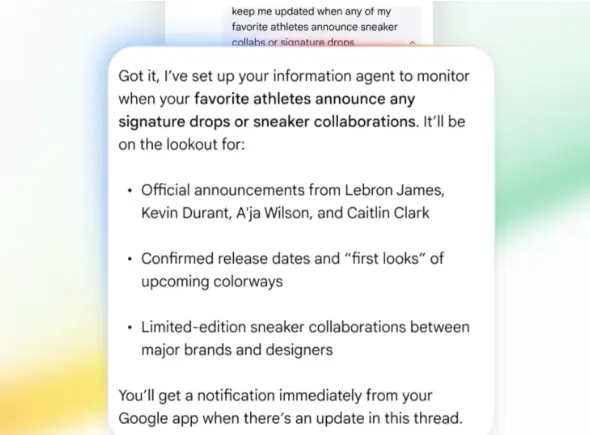
The third is Agentic Search, which allows users to build custom mini-apps, dashboards, and trackers from inside Search using Gemini Spark and Google Antigravity. A query about tracking market movements can produce a live monitoring tool, while questions about apartment hunting can generate a filter and alert system. Search is no longer returning links. It’s producing outputs.
What This Means for Organic Search
The honest read on these announcements is that traditional ranking behavior is already changing. SISTRIX data published in March 2026 documented a collapse in position-one click-through rates in Germany, from 27 percent to 11 percent. AI overviews already reach 2.5 billion monthly users, and AI Mode crossed one billion monthly users in its first year.
Users are already getting answers without clicking, and in the future, Information Agents will provide users with information without initiating a search at all. The interaction model is shifting from reactive to proactive on Google’s end.
For brands, this changes two things. First, appearing in AI-generated answers is now as important as ranking in traditional results. Second, being visible to information agents is a new form of visibility that did not exist before. Both depend on the same foundation: content that is clear, authoritative, structured, and genuinely useful.
Why Existing SEO Foundations Still Win
The temptation after an announcement like this is to treat everything as a disruption requiring new tactics but the reality is more grounding. The structures we have been building (e.g., entity authority, intent-matched content, technical accessibility, and strong E-E-A-T signals) are precisely what AI-native search rewards.
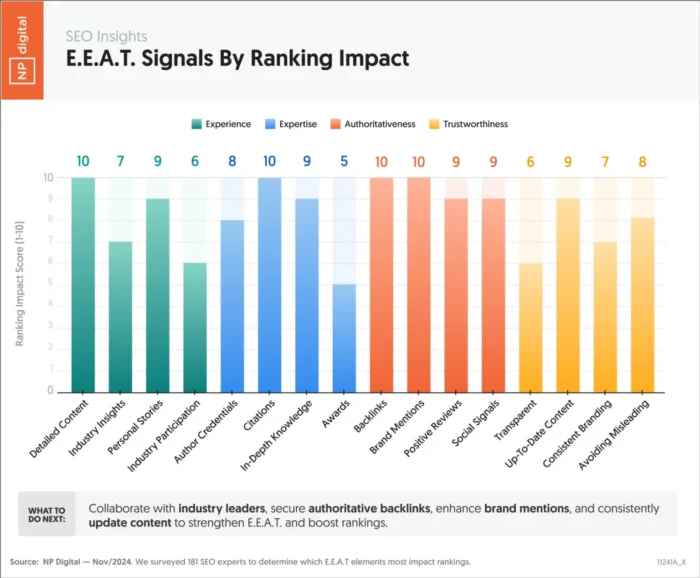
Agentic formats and generative user interfaces (UI) are new creative outputs, not replacements for content quality. An information agent monitoring a topic for a user will surface the by being authoritative, current, and clearly structured, which are the same qualities that drive strong traditional rankings
What changes is the scope of optimization. Brands now need to think about how their content performs in AI-generated answers, not only in ranked results. That means writing content that answers questions directly, using structured data appropriately, and building topical authority deep enough to earn citation across a range of related queries.
The Click-Through Collapse Is Already Happening
Before the I/O announcements, the underlying data was already telling this story. Position-one click-through rates have fallen across a variety of industries as AI Overviews expanded. That is not a future projection. It is a current reality in every category where AI Overviews appear consistently.
The implication is not that ranking has become less important. It is that ranking has become more important while delivering less traffic per position. A brand that holds position one and earns a citation in the AI Overview above it is doing as well as possible in the current environment. A brand that holds position one but does not appear in AI features is exposed to ongoing CTR erosion without the additional visibility.
This creates a new dual-visibility mandate: perform in traditional organic results and earn citation in AI features simultaneously. These are related but not identical optimization problems. Content that ranks well and earns AI citation is an asset. Content that ranks well but fails to earn AI citation is a risk.
What to Do Now
Audit your highest-value pages for AI readability. Ask whether an AI system could produce an accurate, complete summary of your content from what you have published. If the answer is “no,” that’s a gap worth closing.
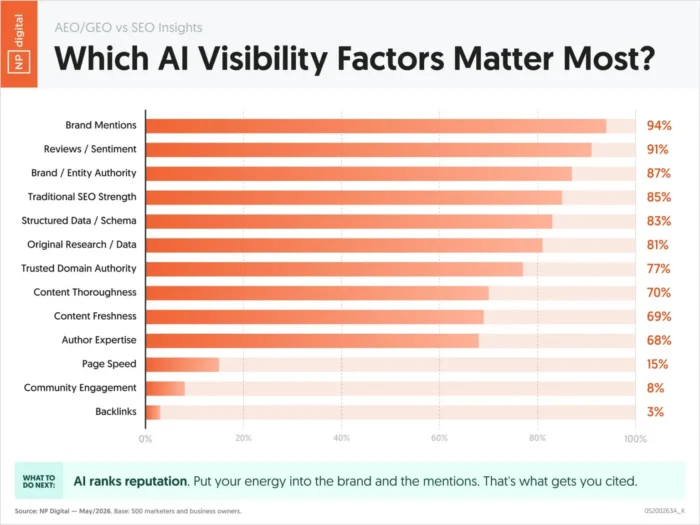
Identify opportunities in emerging agentic formats. Information agents will surfacends that build comprehensive, current, well-organized content around their core topics will be the ones those agents trust
Prioritize non-commodity content. Google has been explicit on this point across multiple communications. Content that adds original data, unique expertise, or genuine perspective will outperform content that simply covers topics already well-served on the web.
Monitor how your brand appears in AI Mode responses, not just in traditional rankings. These are now two distinct visibility channels, and both require attention.
Does this change my existing SEO strategy?
Mostly it extends it rather than replacing it. The content quality, entity authority, and technical accessibility standards that drive strong traditional rankings are the same foundations that determine AI citation. What is new is the need to monitor AI visibility specifically and optimize for answer-engine citation alongside traditional ranking.
When do Information Agents launch?
Information Agents are rolling out first for Google AI Pro and Ultra subscribers in the United States during the summer of 2026, with broader availability planned for 2027.
Does ranking still matter if AI answers the query directly?
Yes, and arguably more than before. AI systems citestructured pages from high-trust domains are significantly more likely to earn citations. And for transactional or navigational queries where users still click, ranking position continues to drive meaningful traffic
What is Agentic Search and should brands care about it now?
Agentic Search lets users build custom tools inside Search using Gemini Spark and Google Antigravity. In its current early rollout, it is most relevant to brands watching where search interfaces are headed. In the medium term, it will matter most for brands whose audiences track time-sensitive information: pricing, inventory, news, market data.
Conclusion
These recent announcements confirm a trend that has been developing for several years. AI is the primary interaction layer. Traditional blue-link results are becoming one output format among many. Users will increasingly get answers, alerts, and tools without clicking anywhere at all.
Notably, though not everyone is excited about this shift. In fact, as anti-AI sentiment grows, some users are actively switching to search engines like DuckDuckGo. Monitoring customer usage of alternative search engines (and optimizing for them if needed) is key.
The brands that will win in this environment are already building the kind of content that earns citation, authority, and trust. The work has not changed. The surface it needs to perform on has expanded.
