


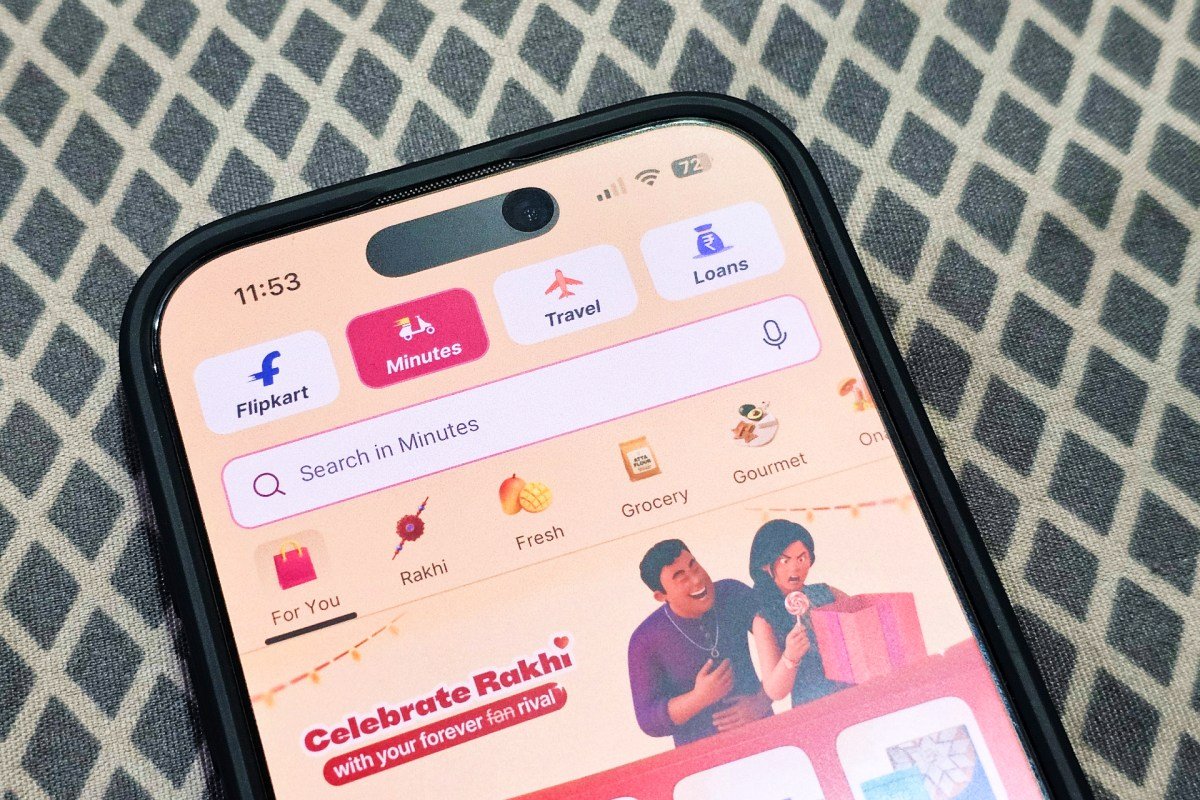
Indian startups spent years getting consumers accustomed to having groceries and everyday goods delivered within minutes. Now Walmart-owned Flipkart is rapidly closing the gap with those quick-commerce pioneers, as global rival Amazon mounts its own push into instant delivery.
Flipkart Minutes, which debuted in August 2024 as the e-commerce giant’s foray into quick commerce, is now delivering 1.1 million to 1.2 million orders a day, up from about 390,000 to 400,000 in November, people familiar with the matter told TechCrunch. That puts the two-year-old service close to Swiggy’s Instamart, which is delivering about 1.4 million orders a day, according to a person familiar with its operations.
The gap is notable as Flipkart is a relative latecomer to a market whose top ranks have been dominated by Instamart, Blinkit, and Zepto. Food-delivery giant Swiggy launched Instamart in 2020 and Zepto arrived the following year, both during the pandemic, while Blinkit traces its roots to online grocery platform Grofers, founded in 2013. The three have since established themselves as India’s top quick-commerce players.
Blinkit continues to dominate the market with around 3.4 million to 3.6 million daily orders, followed by Zepto at about 2.4 million to 2.6 million, per recent estimates from market research firm Datum Intelligence. Flipkart is now rapidly narrowing the gap with Instamart, the smallest of the three established leaders by order volume.
Instamart still has substantial scale. Earlier this month, Swiggy said the quick commerce service has more than 14 million monthly transacting users and operates over 1,200 dark stores across over 130 cities. The company has also been narrowing Instamart’s contribution-margin losses, with more than 45% of its dark-store network now contribution-margin positive.
Nonetheless, Flipkart has fueled that growth with an aggressive expansion of its delivery infrastructure. Minutes now operates about 1,020 to 1,050 micro-fulfillment centers — essentially small warehouses located close to customers specially to handle quick deliveries — up from 600 in January and about 340 a year ago, one of theilities a month, the
Flipkart’s advantage goes beyond adding dark stores. The company can tap an enormous pool of existing e-commerce customers it has already spent years and billions of dollars acquiring, giving Minutes a ready audience for faster deliveries, Satish Meena, an adviser at Datum Intelligence, told TechCrunch.
“Flipkart is already a serious player,” Meena said. “Once you open 1,000 dark stores and [are] doing a million orders per day, it’s serious enough.”
Minutes is also seeing customers return and shop more frequently. About 65% to 70% of customers making purchases on the service each month are repeat buyers, while transactions per customer have increased 50% to 60% from a year earlier, people familiar with the matter said.
Those customers are spending an average of about ₹400 to ₹500 (about $4.20–$5.20) per order, with fruits and vegetables, staples, dairy, and meat among the fast-growing categories, thend gourmet products, including organic and artisanal items, as it looks to capture more of customers’ spending on Minutes
Even as Minutes has expanded, its average delivery time has fallen to about 11 minutes, from 13 minutes a year ago, one of the
A battle for India’s shoppers
Flipkart’s growth comes as quick commerce takes a bigger role in how Indians shop online, even as broader consumer demand has shown signs of weakness. In a recent report, Bernstein analysts said while the country’s consumption growth softened in July, a shift toward quick commerce and e-commerce continued, with quick-commerce platforms recording healthy growth in monthly active users.
Similar to Flipkart, Amazon is striving to gain its share in the Indian quick-commerce market. The Seattle-based company has been expanding Amazon Now, its quick-commerce service, as it seeks to bring the instant-delivery model to its existing e-commerce customer base.
During CEO Andy Jassy’s visit to India in June, Amazon stated that Now became its fastest-growing business in India, with orders doubling every quarter since launch. The company also laid out plans to take the service to more than 300 cities and set up a network of more than 1,000 micro-fulfilment centers, alongside larger facilities aimed at expanding the range of products it can deliver within minutes.
Amazon, Flipkart, Swiggy, Zepto, and Blinkit parent Eternal did not respond to requests for comment.
The wuick commerce expansion is increasingly defensive as well as offensive for both Flipkart and Amazon, Meena told TechCrunch. As consumers grow accustomed to receiving certain purchases almost immediately, the e-commerce giants risk losing those transactions to specialist quick-commerce platforms if they cannot offer comparable speed.
“Can you go back to scheduled delivery now in grocery? No,” Meena said. “You will not go back.”
