


When Alexandru Voica, head of corporate affairs at the video-generation startup Synthesia, sent me a link this summer to the newest addition to their PR team, I was surprised. It was aninteractive virtual avatar of him, trained to answer common press questions about Synthesia, like what it does and how it works. The day before, I was on a panel where PR people asked me if I minded pitches that used AI-generated text. But Alexandru’s avatar was beyond that — this seemed to me the final boss of using AI in PR.
In September, Synthesia invited me to its new office space in New York. Originally based in the U.K., Synthesia is a hot digital avatar startup alongside others like D-ID, HeyGen, and Colossyan. It hit a $4 billion valuation earlier this year and said last year it had crossed <a href="https://www.synthesia.io/post/100-million-revenue-adobe-investment” rel=”nofollow noopener” target=”_blank”>$100 million in ARR.
Synthesia lets enterprises build interactive training videos with AI avatars and recently launched a product called Roleplay Sessions that lets employees practice, for example, sales pitches with an interactive AI avatar that responds and scores their responses.
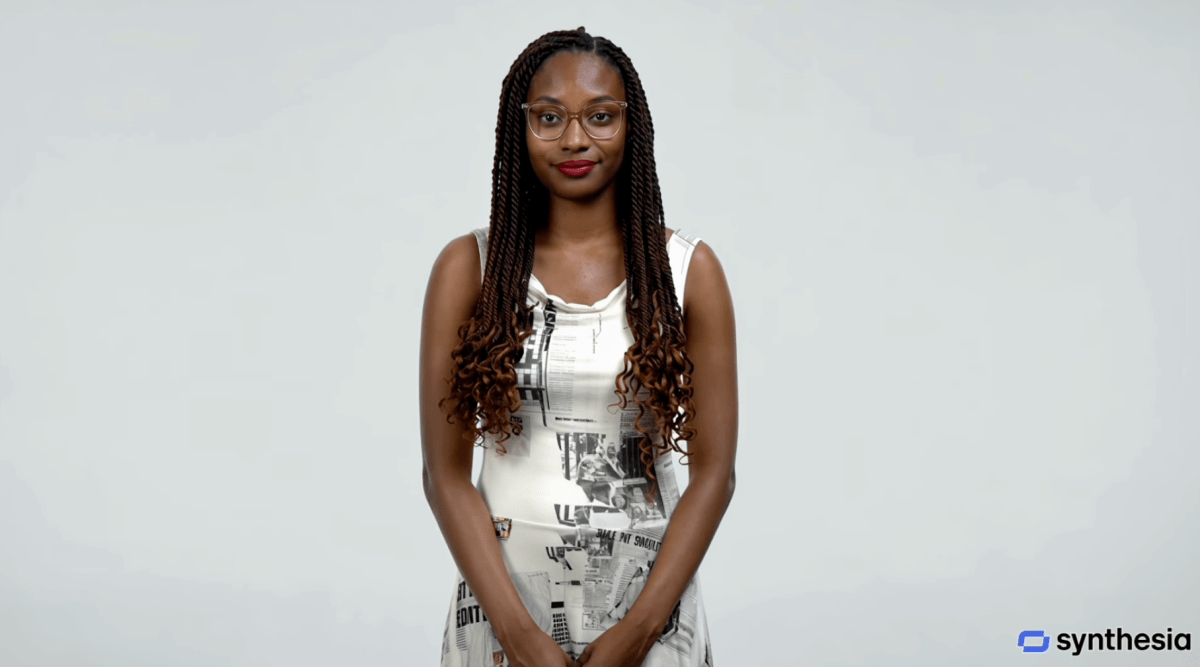
When I went to the new office opening and they asked me if I would like my own AI avatar, I didn’t even hesitate to say yes. Of course I would like my own digital twin. My outfit was cute that day, and my hair was in place.
Until I met my digital twin, I had been indifferent toward avatars, but I felt they would inevitably become part of everyday online life. I heard of people on Instagram creating them in their likenesses to help them make social content. I find it all to be very interesting, and it’s perhaps why I have no qualms now presenting to you my digital twin. This is the first time Synethsia has made a digital avatar for a journalist (or for anyone, period, outside of Voica). It is trained on my story about why venture-backed startups commit more fraud than non-VC-backed startups and will only answer questions about that story.
Below, simply press “start in a new window” to begin.
You can ask it questions like:
- Why did I decide to write this story?
- What is the research paper about?
- What did the researchers find?
To make this, I entered a mini film studio nestled inside Synthesia’s office where they took numerous photos of me and captured a two-minute recording of my voice. I had to consent to these avatars being made and, well, digital Dom was born. They created a personal avatar for me (one that just reads whatever script I give it) — with and without glasses — and they made two interactive avatars for me (ones that can talk back and listen to me), also with and without glasses.
We picked an article to train the interactive avatar on, and then one of the teams built my interactive avatar, which is powered by a combination of voice-to-text, video, language, and text-to-voice models. My avatar’s tech stack includes Synthesia’s own video and voice models, although the company also allows customers to choose alternatives from other labs like Cartesia, ElevenLabs, Google, or OpenAI. Enterprises can also choose to host their avatars on whatever cloud they want or pay Synthesia to host them.
The voice-to-text model turns what people say into text, the agentic language model makes sense of text and can take actions based on it, the text-to-voice model turns a response into audio, and finally a video model (built by Synthesia) animates the avatar as it talks.
Overall, Synthesia builds three types of products — a video-creation and distribution platform with classic avatars, where someone types in a script and the avatar repeats it; an agentic platform called Sessions where people can interact with the avatars in surveys or roleplay; and an API platform where people can take Synthesia video and voice models and combine them with other tech services to build interactive avatars or other types of products.
It took the Synthesia team a couple of days to make my avatars. I played first with the personal ones and typed a fairly generic script to see how my AI voice sounded. I had it talk about how fall has arrived in New York, my favorite time of year. The voice was fairly accurate, and I was glad it didn’t pick up any of the hoarseness I had when I recorded my audio sample.
I showed it to some non-tech friends who found it both interesting and creepy.
Then I showed them my interactive one, which is deterministic, meaning it will only say what it was trained to respond to. In this case, that was my venture fraud story. I asked it questions like where I was before TechCrunch and what part of New York I lived in, but each time it directed me back to the story.
My friends didn’t think the voice sounded much like mine and thought the likeness was not as good as the personal avatar, but nonetheless it was close enough to be somewhat creepy. My mom called it “amazing,” which is pretty high praise from her. She and my father kept trying to ask it questions “only they would know” about me — but the model didn’t answer, redirecting them each time to the venture fraud story.
“I don’t remember giving birth to two of you,” she joked after testing the model.
This experience has made me think about what the future of journalism could be. Would people be OK with turning on the news and it being presented by an avatar? One investor told me no immediately. Certainly there is a lot of pushback today on AI slop that has infiltrated social media and other news-sharing platforms. But others I asked weren’t so sure. Could avatars augment — or even replace — journalists? Would CEOs want to talk to an AI avatar of a journalist rather than a human one?
What I like about my career is connecting with people, writing stories, and researching new topics. But the biggest part of journalism is trust. That doesn’t seem like it could ever be out
Outside of journalism, I’m confident the idea of cloning yourself could be appealing. No more catching up on work after a holiday or vacation, because a version of you can always be around, answering questions.
We’ll have to see how avatar usage evolves in corporate America. But now that I have my own, I have mixed feelings. After I got over the initial novelty of it, I examined my avatar closely after it stopped talking and waited — for what, I’m not sure. Maybe I’m waiting for it to blink. Or to say something new, or to smile, or to just let me know that it knows.
Because my digital twins are deterministic, they will never do that. But I can see how easy it would be for someone to fall into a tinge of AI psychosis with one that was nondeterministic, meaning powered by a chatbot that was free to pontificate.
I told one investor that, whatever the future of digital twins is, I predict that my generation, Gen Z, likely won’t get used to them. They feel sci-fi: Everything we’ve ever seen in a movie is here now. But I will say, I find digital avatars less jarring than humanoids. At least with an avatar, if stuff gets weird, I can always log off.
Until then, however, here is my personal avatar, giving you a rundown of all the top stories on our site this week!
