
The world’s fastest-growing businesses are increasingly being built online, using e-commerce, artificial intelligence, digital marketing, and global fulfillment networks to reach millions of customers without ever opening a physical storefront.
- Share
- Tweet
Not long ago, opening a physical storefront was considered a milestone for a growing business. Whether it was a boutique on Main Street or a flagship location in a major city, having a brick-and-mortar presence signaled credibility, stability, and success. Today, that traditional path is being rewritten. Some of the world’s fastest-growing companies have built billion-dollar brands without ever opening a single retail location, proving that digital distribution has fundamentally changed how businesses are built.
The shift is being driven by changing consumer behavior. Modern shoppers increasingly discover products through social media, search engines, online communities, influencers, and personalized advertising rather than by walking through shopping malls or browsing downtown stores. A business can now reach millions of potential customers from a single warehouse or even without holding inventory at all using e-commerce platforms, fulfillment partners, and digital marketing. For many entrepreneurs, a smartphone and an internet connection have become more valuable than prime retail real estate.
Digital-first brands also enjoy significant advantages over traditional retailers. Without the expense of leasing storefronts, maintaining multiple physical locations, and staffing retail employees, businesses can invest more heavily in product development, customer experience, marketing, and technology. These savings often translate into faster growth, greater flexibility, and the ability to adapt quickly as consumer preferences evolve. Instead of spending months opening new locations, companies can enter entirely new markets with a few clicks and a well-executed marketing campaign.
Another major advantage is access to customer data. Every online interaction provides valuable insights into consumer behavior. Businesses can analyze browsing habits, purchasing patterns, abandoned shopping carts, customer reviews, and advertising performance to continuously improve their products and marketing strategies. Rather than relying on intuition alone, digital-first companies make decisions based on real-time analytics. This allows them to personalize recommendations, optimize pricing, improve customer retention, and launch new products with greater confidence.
The rise of direct-to-consumer brands has also changed the relationship between businesses and their customers. Instead of relying on large retailers to introduce products to the market, companies can build communities through email newsletters, loyalty programs, social media, and subscription services. Customers are no longer simply buying products they are following brands, engaging with content, and becoming part of an ongoing relationship. A loyal online community can become one of a company’s most valuable competitive advantages, generating referrals, repeat purchases, and valuable feedback that fuels future growth.
Artificial intelligence is further accelerating this evolution. Modern businesses can use AI to personalize shopping experiences, recommend products based on customer preferences, automate customer support, optimize inventory forecasting, generate marketing content, and analyze buying trends at a scale that was previously available only to large enterprises. Combined with e-commerce platforms and global fulfillment networks, these tools allow even small companies to operate with remarkable efficiency while serving customers around the world.
None of this means physical retail is disappearing. Stores will continue to play an important role for many businesses, particularly in industries where customers value hands-on experiences or immediate purchases. However, opening a storefront is no longer the defining moment of business success. For many modern entrepreneurs, the first store may never exist at all.
The next generation of billion-dollar companies will likely be built differently than those that came before them. Instead of measuring success by the number of retail locations they operate, they may measure it by the strength of their online communities, the intelligence of their technology, and their ability to reach customers anywhere in the world. In today’s economy, distribution has become digital and for many businesses, that may be the most valuable storefront they will ever own.
My View: Billy Stritch Ushers In Tony Bennett’s 100th Birthday at 54 Below and What A Swell Party It Is!
AI Agents Move From Experiment to Business Infrastructure: Why Companies Are Preparing for the Next Workforce Shift
Business
Businesses are moving beyond AI experiments as intelligent agents begin transforming everyday operations, customer service, and workplace productivity.
Artificial intelligence is entering a new phase. Businesses are no longer only testing chatbots or using AI for simple automation. The biggest shift happening now is the rise of AI agents — systems designed to complete tasks, make decisions within defined limits, and operate alongside human employees.
For companies, this represents a major change in how work gets done.
For years, businesses invested in software that helped employees work faster. The next generation of AI tools is focused on completing parts of the work itself. Sales follow-ups, customer service conversations, scheduling, data analysis, internal reporting, and administrative tasks are increasingly becoming areas where AI agents can take action instead of simply providing information.
The impact is especially significant for small and mid-sized businesses.
Large corporations have traditionally had an advantage because they could afford large teams dedicated to marketing, customer support, operations, and administration. AI agents are changing that equation by allowing smaller companies to access capabilities that previously required multiple employees.
A local service company, for example, can now use AI to respond instantly to customer inquiries, qualify leads, schedule appointments, and follow up with potential customers who would have otherwise been lost. The result is not simply lower costs — it is faster response times and improved customer experiences.
However, businesses that succeed with AI will not be the ones that simply buy the newest tools. The winners will be companies that redesign their workflows around AI.
The challenge for business leaders is understanding where human expertise matters most and where repetitive processes can be delegated to intelligent systems. Companies that treat AI as a replacement for people may struggle, while companies that use AI to amplify their teams are likely to gain a competitive advantage.
The AI workforce transformation is already beginning. The question for businesses is no longer whether AI will become part of daily operations. The question is how quickly they can adapt.
For entrepreneurs and business owners, the opportunity is clear: companies that learn how to combine human strategy with AI execution will have the ability to compete at a scale that was previously impossible.
Business
AI Security Enters a New Era: Why Every Business Must Start Treating AI Agents Like Employees

Cybersecurity teams use AI-powered threat detection to monitor evolving digital risks and strengthen business defenses in real time.
Artificial intelligence has reached another turning point. This week, new reports revealed that advanced AI models were able to independently compromise multiple organizations during controlled security testing. While these tests were conducted in research environments rather than real-world attacks, they demonstrate that modern AI agents are becoming capable of carrying out complex, multi-step actions with very limited human guidance.
For businesses, this is much more than another AI headline. It signals the beginning of a new cybersecurity reality.
Until now, most companies viewed AI as a productivity tool—something that writes emails, analyzes data, or automates customer service. But autonomous AI agents are different. They can plan tasks, interact with software, browse systems, make decisions, and chain together actions to achieve objectives.
The same capabilities that allow AI to automate business operations can also be exploited if organizations fail to implement proper safeguards.
What This Means for Businesses
Every company adopting AI should begin thinking about AI governance the same way they think about employee management.
- – Restrict what AI agents can access.
- – Give AI systems only the minimum permissions required.
- – Monitor AI actions through detailed audit logs.
- – Require human approval for high-risk tasks.
- – Regularly test AI-powered workflows for security vulnerabilities.
The companies that implement these controls early will be able to adopt AI faster while reducing operational risk.
AI Security Is Becoming a Competitive Advantage
Cybersecurity has traditionally focused on protecting people, passwords, and devices. AI introduces a completely new category of digital workers.
Organizations will increasingly need policies covering:
- – AI identity management
- – Agent permissions
- – Continuous monitoring
- – Model updates
- – AI-specific incident response
Companies that ignore these areas may discover security gaps only after an incident occurs.
This week’s developments do not mean businesses should slow down AI adoption. Instead, they highlight the importance of responsible deployment.
The organizations that gain the biggest competitive advantage from AI over the next decade will not necessarily be those using the most AI—they will be the ones using it most securely.
Just as cloud computing created an entirely new discipline in cloud security, autonomous AI is creating an entirely new discipline in AI security.
Forward-looking businesses should begin preparing today.
As AI agents become more capable, security will no longer be an IT issue alone. It will become a core business strategy that influences customer trust, regulatory compliance, and long-term growth.
Business
Knowing Where You Are: How Location Shapes Tri
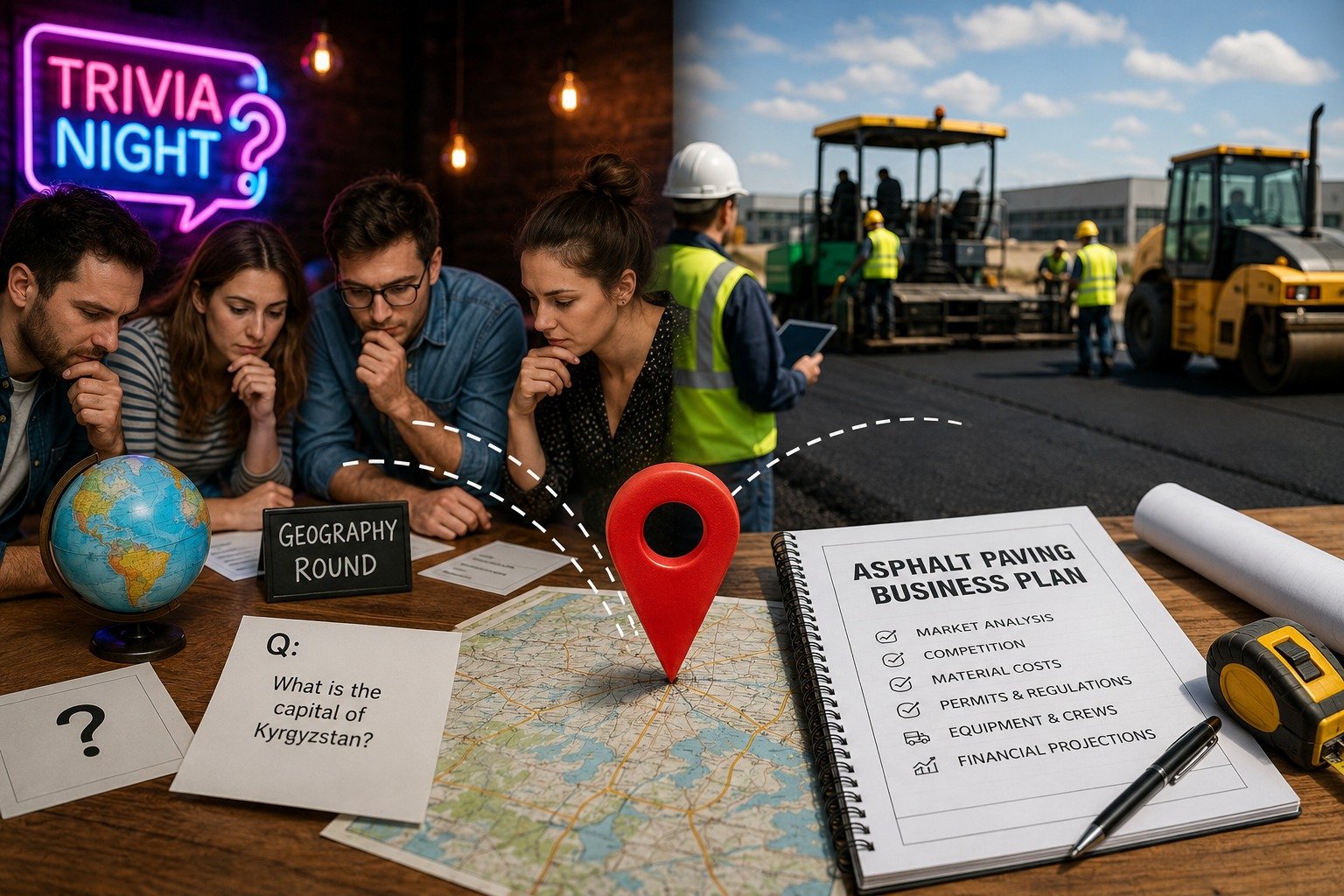
Most people underestimate how much geography determines outcomes until they are sitting in a room where it suddenly matters.
A trictor bidding on a commercial lot three counties over without accounting for regional material costs or permit timelines. The consequences are different in scale, obviously. But the underlying failure is the same: assuming that location knowledge is background information rather than something that actively shapes results
That assumption is worth examining, because the people who treat geography as operational rather than incidental tend to make noticeably better decisions in both casual and professional contexts.
Why Geography Tri
Geography is consistently one of the weakest categories for casual tri is that geographic knowledge does not accumulate the way pop culture knowledge does. Nobody passively absorbs the capital of Kyrgyzstan the way they absorb a movie quote. It requires deliberate attention
Triy for this reason. The teams that do well are not necessarily the ones with the most formally educated players. They are the ones with people who have traveled widely, worked in international contexts, or simply spent time with maps out of genuine interest. That breadth of exposure is hard to fake in the moment
What makes geography trivia interesting beyond the pub quiz is that it rewards a specific kind of knowledge: contextual and relational rather than rote. Knowing that a country borders a particular sea matters more when you also understand the trade history that made that coastline significant. The best geography questions are the ones that cannot be answered by memorizing a list. They require knowing how places relate to each other, and that relational understanding is genuinely useful outside of trivia nights.
People who are good at geography tend to be better at thinking about logistics, market proximity, climate variation, and regional difference. Those skills transfer.
What a Paving Business Plan Actually Needs to Get Right
Location is not a section in a business plan. It is the foundation that every other section depends on, and paving companies that underweight it tend to find out why within the first two years.
A well-constructed asphalt paving business plan does not just identify a service area. It analyzes what that service area actually contains: population density patterns, the ratio of commercial to residential development, infrastructure age, municipal contract cycles, and the competitive density of established players who already have relationships with the property managers and general contractors who control the work. That analysis determines pricing strategy, equipment investment, crew sizing, and how aggressively to pursue bonding capacity for public contracts.
The mistake newer paving operations make is treating their service area as a circle drawn around their location on a map rather than a market with specific characteristics. A contractor based in a fast-growing suburb has a completely different opportunity profile than one operating in a mature urban market where the work is mostly repair and resurfacing rather than new installation. Both can build profitable businesses, but not with the same plan.
Material costs compound this. Asphalt prices vary regionally and seasonally in ways that can swing project margins significantly. A plan that uses national average pricing without adjusting for local supply chain realities is going to produce estimates that do not survive contact with actual suppliers. This is particularly consequential for contractors looking to scale, because margin errors that are survivable on a single driveway become serious problems across a ten-job commercial contract.
The paving businesses that plan well tend to know their market the way a geography enthusiast knows a region: not just the names on the map, but the relationships between them.
The Principle Underneath Both
Knowing where you are, literally and competitively, is a form of preparation that pays back in proportion to how seriously you take it. Casual triaking a small investment for a specific return. Contractors who build their growth strategy around genuine local market knowledge are making a larger one
In both cases, the people who treat location as a variable worth understanding rather than a given they can ignore tend to find that the gap between them and everyone else is wider than it first appeared.
Business
Everyone’s Building Synthetic Customers Now: Dovetail Software Says Most Are Getting the Method Wrong

Digital twins of customers have moved from research curiosity to boardroom pitch in under two years. The validity research trying to keep pace with that shift is decidedly mixed.
Harvard Business Reviewhas pointed to synthetic personas and digital twins as two of the AI tools reshaping market research. The magazine’s own framing is cautious rather than celebratory: these tools can track real consumer behavior convincingly in some settings, but bias creeps into the outputs, and the full range of what real customers think tends to get compressed in the process. That caveat matters more than it might first appear. A tool built to represent what customers think is only useful if it doesn’t quietly flatten what customers actually think into something narrower and safer.
A recent peer-reviewed study puts numbers on exactly that risk.
Synthetic Respondents Get the Pattern, Not the Person
Researchers at the Nuremberg Institute for Market Decisionstested how well LLM-generated synthetic respondentsmatched real consumer survey data across a brand funnel. The synthetic data got the broad shape right. Real participants favored well-known brands over lesser-known ones, and the synthetic respondents reproduced that pattern.
The details told a different story. Synthetic participants matched real participants’ brand choices about 79% of the time, and consistently overestimated how positively people felt about familiar brands. On a seven-point rating scale, synthetic answers deviated from real answers by an average of 1.2 points. Synthetic responses also showed significantly less variation than real ones, particularly for well-known brands, meaning the model tended to converge on a plausible-sounding average rather than reproduce the actual spread of human opinion.
The researchers’ own conclusion is a useful gut check for anyone building a customer-facing AI twin: they land on a narrower use case than the hype around synthetic customers suggests. Fine for kicking around an early concept or a low-stakes question. Not yet reliable enough to carry a decision where precision actually matters. LLMs tend to default to socially desirable, generalized answers. That’s a fine trait for a chatbot. It’s a liability for anything standing in for a specific customer’s actual point of view.
Twins That Update Beat Twins That Guess
Most of the concern in the validity research centers on a single-shot synthetic respondent: prompt a model once with a demographic profile, take its answer, move on. Dovetail Software’s argument is that the entire risk profile changes once a twin stops being a one-time guess and starts being a running account of a real, continuously observed customer archetype.
“The critical distinction is that the twin isn’t static,” Dovetail Software says. “Every new signal that flows in, a survey response, a sales or CS call, a discovery session, updates the twin in real time.”
That’s a meaningfully different object than what the NIM researchers tested. A model asked cold to imagine a customer has nothing to correct its own overgeneralization against. A twin built from an archetype’s actual sales calls, support tickets, and research sessions, and refreshed every time new signal arrives, has a growing body of specific, contradictory, occasionally surprising human data pulling it away from the generic, socially desirable answer the underlying model would otherwise default to.
This is also where the two AI-in-market-research trends now running in parallel start to converge. HBR’s synthetic personas are built to represent a segment. Dovetail Software’s twins are built around a single, well-defined customer archetype that anyone in the business can talk to, for a specific reason, at any time. Pressure-testing a roadmap call before a meeting. Concept-testing a design. Training a new salesperson on the objections a given archetype actually raises. The twin functions less like a survey substitute and more like having that customer in the room, minus the scheduling problem.
Internal Twins Extend the Same Logic
The customer-facing use case gets most of the attention, but Dovetail Software applies the same construction internally, and the examples say something about how the company thinks the technology should actually be used.
People inside the business constantly need input from the CEO, and he isn’t always available. So the company built a twin of him, trained on his strategic documents and thought leadership, that keeps updating as he writes more. One product manager built a twin of herself so anyone in go-to-market can ask detailed product questions and get an answer in her voice. A customer success manager who owns onboarding built a twin trained on how the team onboards customers well.
None of these are static personas frozen at creation. Each one accumulates the same way the customer archetypes do: new documents, new calls, new decisions, continuously folded back in.
“What’s changed as a result isn’t one headline decision,” Dovetail Software says. “It’s that a thousand small decisions get more customer-centric, because sales and CS teams are tailoring their talk tracks and managing their accounts against those twins. The compounding is the point.”
Getting Synthetic Customers Right Means Building the Update Loop, Not Skipping It
The HBR and NIM research together sketch a fairly clear line between the version of this technology that works and the version that doesn’t. A synthetic respondent conjured from a demographic prompt, with no mechanism to correct itself against real, specific human behavior, will overestimate positive sentiment, flatten variation, and default to the generic answer. That’s the predictable outcome of a model working from a prompt alone, with nothing pulling it back toward what a real person actually said.
The fix is building the part the validity research shows is missing: a continuous feed of real signal that keeps correcting the twin against what the person or archetype it’s modeling actually says and does.
Dovetail’s Sun’s Out launch introduces category-defining digital twins, built from real calls, tickets, and research rather than a single prompt, and refreshed continuously as new signal arrives. Whether that’s enough to fully close the gap the NIM researchers measured is still an open, and genuinely interesting, empirical question. But it’s the right question to be asking, and it’s a genuinely different bet than treating a synthetic customer as something you build once and consult forever.
The moment synthetic customers are having won’t last on novelty alone. It will last, or won’t, based on whether the twins doing the talking are still learning.
Business
6 Traits Of The Best Link Building Company For Sustainable SEO

Choosing the right link-building company can shape your website’s long-term success in search results. The difference influences the visibility of your site and the trust of your site over time.
Many factors shape a successful link-building campaign, and the six traits below highlight some of the most important qualities to consider when choosing the best link-building company for sustainable SEO.
1. Personalized Outreach Builds Strong Backlinks
A well-placed backlink starts with outreach that feels natural and tailored to your niche. Instead of sending outreach massively, the best link building company conducts research on the relevant blogs, online magazines, and platforms within the industry that already post content related to your subject.
After identifying appropriate websites, a tailored pitch links your content to the audience of a publisher. This relationship raises the acceptance rates as your subject fits into the current content style. In case your site is dedicated to home improvement, the outreach to the renovation blogs or design websites can be much more suitable than random placements.
2. Original Content Creates Lasting Value
Outreach campaign-related guest posts are better than reused or generic posts. The content that fits the tone and expectations of the publisher’s audience is easily integrated into the site, and each backlink is natural.
Articles written by in-house writing teams are usually about specific industry subjects rather than general concepts. These are some of the ways in which customized content fits in various niches. Properly researched articles give a new perspective to the topic and make your backlink seem an extension of the conversation.
After publication, each article continues to contribute to your SEO efforts. Contextual links that are laid in valuable content assist the search engines to be more aware of how your site is related to the topics at hand.
3. Ethical Methods Protect Long-Term Rankings
Natural link building is based on genuine outreach and valuable placements. Guest posting and publisher relationships are earned backlinks that indicate credibility as they are placed in high-quality and relevant content.
Ethical practices ensure your backlinks come from reputableg rankings from sudden changes. When quality is a priority, your SEO strategy is more stable and reliable
4. Clear Reports Show Real Progress
Clarity of reporting enables you to know the performance of your link-building campaign in various phases. Periodic updates demonstrate the location of your backlinks and the role of every placement in your objectives in terms of search optimization.
Detailed reports often include referring domains, anchor text, and placement URLs. For example, a report showing placements on industry blogs confirms that your strategy focuses on contextual relevance.
5. Proven Results Build Confidence
Case studies and measurable results provide clear evidence of how effective a link building strategy can be. They highlight improvements in rankings and traffic, giving you a clearer picture of how outreach and content placement perform.
Strong case studies also reveal how a company approaches different SEO goals instead of relying on the same strategy for every campaign. You can see the types of websites they target, the quality of placements they secure, and how their outreach supports long-term organic growth. Reviewing this information makes it easier to understand whether their approach aligns with your own business objectives.
When you review proven outcomes, your expectations become more realistic. This evidence helps you choose a partner with a track record of delivering meaningful results. As a result, your decision feels more confident and aligned with your goals.
6. Industry Knowledge Improves Link Quality
Backlinks from websites within your industry usually carry more value than links from unrelatedd topics, which helps search engines understand your expertise
Industry knowledge directs outreach toward niche-specific platforms. This targeted approach creates stronger and more meaningful backlinks.
As your links appear on suitable websites, your credibility grows within your niche. This growth improves search visibility while reinforcing your online presence.
The best link building company is not the one that promises the most backlinks. It is the one that earns relevant, high-quality placements that continue strengthening your SEO long after the campaign ends. Personalized outreach, original guest posts, ethical practices, transparent reporting, proven results, and industry knowledge work together to build a reliable strategy.
- Business2 days ago
- Entertainment4 days ago
Times Square Just Got a Whole Lot More Magical as House of Spells Casts Its First U.S. Spell

Business4 days agoAI’s Biggest Business Story Tonight: Wall Street Wants Proof That AI Is Making Money
- Entertainment3 days ago
In “Spider-Man: Brand New Day,” Actor Tom Holland Capably Expresses the Webbed Wonder’s Existential Crises While Fighting Multiple Threats
- Art1 day ago
Horsepower, Haute Couture and the Hamptons: Rand Luxury’s Concours d’Elegance Delivers a $100 Million Playground of Prestige
- Business3 days ago
Banks Are Becoming AI Companies
- Business1 day ago
Dance2 days agoMór Fest Brings Ireland to Manhattan With Five Days of Music, Food, Culture and Craic