


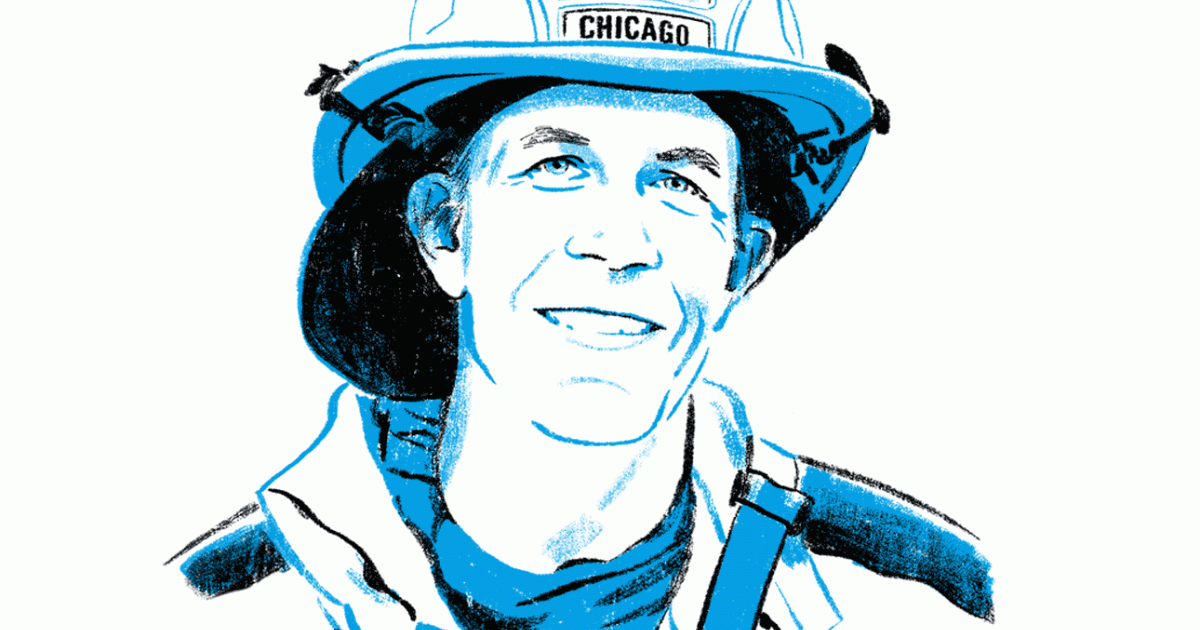
We’re there when you need us. That’s the Chicago Fire Department (CFD) motto. And for my entire 26-year-plus tenure with the CFD, that’s been my duty. I have been a first responder to many of the seminal events in the city’s recent history: the fatal Lincoln Park porch collapse in 2003; the “Snowmageddon” blizzard of 2011; and the civil unrest after the murder of George Floyd in 2020.
I serve as deputy district chief of the CFD’s 1st District, a 45-square-mile area that stretches from Lincoln Park on the North Side to the South Side neighborhoods of Woodlawn and Englewood.
Being a big-city fire chief is a far different career than I had imagined for myself. I began my master’s degree in journalism at Northwestern’s Medill School of Journalism, Media, Integrated Marketing Communications in 1994 and dreamed of becoming a feature writer for a major national magazine.
In the summer of 1995 — when most of my friends were finishing the master’s program with a quarter at Medill’s Washington, D.C., newsroom — I took a couple months off. Short on cash and needing resume-building experience, I returned to my teenage job as a beach lifeguard in Chicago’s Rogers Park neighborhood while doing an internship at a trade magazine.
That summer the CFD offered an entrance exam for the first time in 10 years. I had always been drawn to the fire service, but opportunities were rare. Fortunate to be in Chicago instead of D.C., I took the test and landed on the “well-qualified” list. The qualified applicants waited patiently as the CFD hired us at random, 100 or so at a time, over the next six years.
In fall 1995 I went to D.C. to finish my master’s degree, then spent the next four years as a writer and editor, first at North Shore Magazine and then at Hospitals & Health Networks. In December 1999 the CFD finally called. Even though the job came with an initial 25% pay cut from my senior editor role, I looked forward to the adventure and said “yes” almost immediately.
“Even though the job came with an initial 25% pay cut … I looked forward to the adventure and said ‘yes.’”
A Chicago firefighter’s schedule is 24 hours on duty and 48 hours off. This leaves ample time for a side job, so many firefighters work in the building trades or as attorneys or real estate agents. But I might be the only CFD member moonlighting as a freelance writer.
The balance between these two very different roles energizes me and keeps life interesting. In the fire service I inhabit a practical and often very physical world. Then, as a freelance writer, I exercise my mind by conducting research and working the phones. Over the years I’ve churned out hundreds of newspaper and magazine articles and published three books. My steady paycheck and flexible schedule have allowed me to focus on the types of stories I want to tell, like in-depth features, sports history and Chicago history.
Meanwhile, I steadily climbed the CFD career ladder. And as my path became clear, I returned to Northwestern in 2006, this time to the Kellogg School of Management for a part-time MBA. There I honed the leadership and management tools that I continue to rely on, both in my emergency response duties and during special assignments for CFD curriculum and policy development.
During my Kellogg years I met Emily Cosgrove ’96 (now Emily Serb) at a party. We bonded over our shared Northwestern background; now married for 15 years, we have two tween daughters.
My Northwestern education led directly to two rewarding careers, and indirectly to marriage and family life. Maybe I never nabbed that staff writer job at Outside magazine or The New Yorker, but in hindsight, I couldn’t have imagined a better outcome.
Chris Serb ’95 MS, ’09 MBA has worked for the Chicago Fire Department since 1999. His latest book, Eckie: Walter Eckersall and the Rise of Chicago Sports, was released in October.
